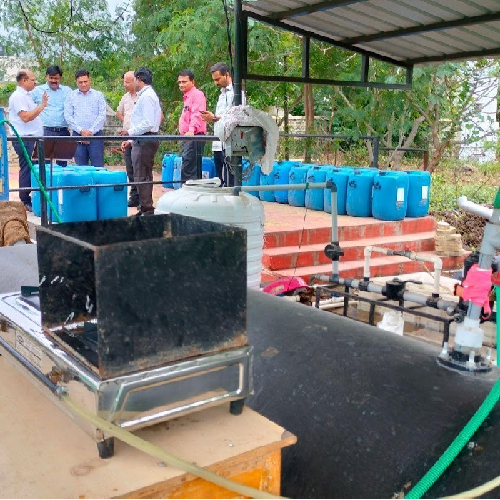




Experience the award-winning Integrated Renewable Energy and Sustainable Agriculture (IRESA) model – a compact 2 cubic meter household biogas plant with BAIF’s patented slurry filtration technology. See how cow dung becomes clean cooking gas, liquid organic fertilizer for drip irrigation, and solid cake for BioPROM (Phosphate Rich Organic Manure) and vermicompost. The Cost of the IRESA is Rs. 55,000/-
BAIF’s IRESA: Integrated Renewable Energy and Sustainable Agriculture
A Bio Gas model which connects the crop-livestock system with a social enterprise model delivers a sustainable solution to address the present agriculture crisis. It efficiently connects and addresses the disjointed yet highly relevant pain points in establishing access to renewable energy, organic production inputs, and generation of gainful self-employment and substantiates farmers’ income by reducing the overall cost of production in the long run.
BAIF has conceived the “Integrated Renewable Energy and Sustainable Agriculture (IRESA)” approach that presents a complete package comprising a portfolio of activities around the central theme of household-level biogas units. The IRESA approach can be a feasible solution for promoting sustainable farming and clean energy use practices. The IRESA approach focuses simultaneously on the optimal use of existing resources for sustainable energy generation for cooking, as well as value-added organic manure production for soil fertility enhancement.
IRESA units are multifunctional and deliver cost-effective integrated solutions to key challenges in underserved geographies.
(a) Provides an integrated model to address soil degradation and poor soil fertility, due to extensive chemical fertilizer usage.
(b) Produce value-added Organic manure and products which can help reduce the use of chemical fertilizers and thereby check the degrading soil health issues;
(c) Provides drip enable liquid slurry which helps in the growth of soil beneficial bacteria near the root zone of the plants
(d) Reduce dependency on LPG and kerosene for cooking and lighting purposes;
(e) Remove the need for the collection of firewood, which reduces the drudgery of rural women and children who undertake this task, as well help preserve forests.
(f) Generate savings on India’s foreign exchange by reducing the import bills associated with Phosphate based chemical fertilizers (31.54% P2O5 Beneficiated Rock Phosphate available in India) and LPG import.
(g) The model is a comprehensive model, providing a solution to household fuel needs as well as is socially, economically, and environmentally relevant.
These household-level IRESA units will be installed with small farmers fulfilling the following pre-requisites.
Household-level availability of 3 milking cattle (2m3 unit shall generate organic cakes of 1 Metric Ton (MT) per annum and the biogas generated shall be sufficient for a House hold with 4-6 members for cooking )
Installation area requirement of approximately 300 square feet. The area should be near the house or farm. Preference should be given to the location near the house. The distance between the unit and the kitchen should not be more than 150 meters.
The IRESA approach focuses simultaneously on the optimal use of existing resources for sustainable energy generation for cooking, as well as value-added organic manure production for soil fertility. By giving proper training and guidance to Farmer Producer Organizations, the IRESA approach can be made operational as a rural enterprise. Unique factors of the model are
- Pre-fabricated biogas unit (2 m3, family size) which is compact, standardized, failure-proof, and clean.
- Produces gas equivalent to 12 LPG cylinders per year or can replace 2.65 metric tons (MT) of firewood with 2 LPG cylinders.
- Ergonomic & efficient slurry handling through an in-house developed low-cost filter (BAIF Slurry Filter*).
- 90% solid recovery, about 1.5 metric tons (MT) (DM) slurry cake per annum. Up to 50% water recycling. Solids – liquids separation.
- Value addition of filtered slurry (residue and filtrate) for enhanced in-situ production of quality organic nutrients resulting in reduced chemical fertilizer use.
- Production of drip-enabled filtered slurry (about 10,000 lit/year) for enhanced production of quality products resulting in reduced chemical fertilizer use.
- Prevents emission of up to 4 metric ton (MT) carbon equivalent per year.
Also explore our large-scale 360 cubic meter community digesters and the innovative Miracle fruit & vegetable waste biogas unit.