
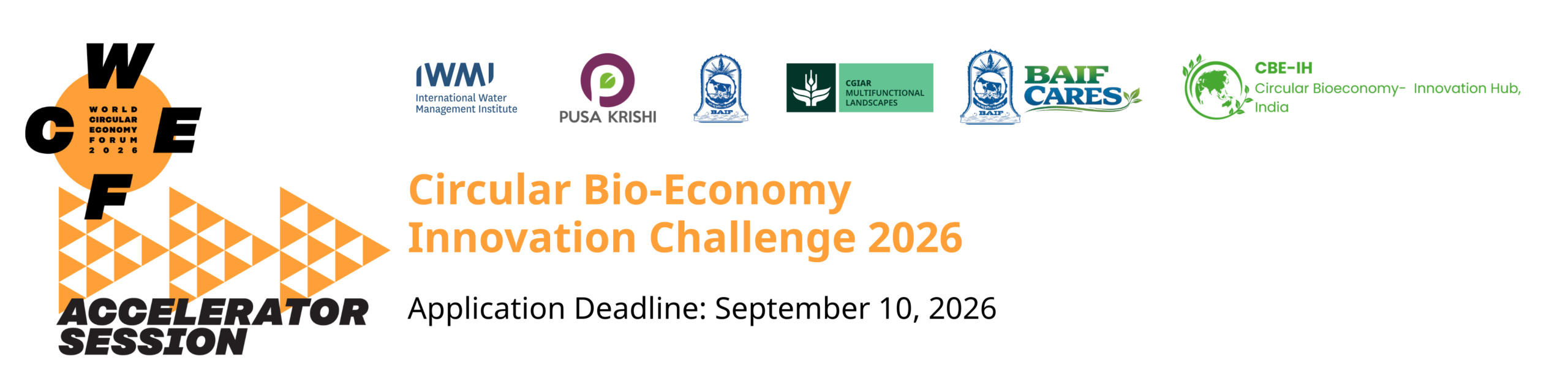
Start Date: 11th Aug. 2026
Location: New Delhi
For more information, please
contact innovationchallenge@baif.org.in
Application Start Date: 11th Aug. 2026
Application End Date: 10th Sept. 2026
ABOUT THE EVENT
International Water Management Institute (IWMI), in collaboration with Pusa Krishi and BAIF Development Research Foundation, is pleased to invite startups, entrepreneurs and impact-driven innovations to participate in the Circular Bio-Economy Innovation Challenge 2026. The focus is to encourage young, women-led, community-based innovators and entrepreneurs to showcase their innovations around the concept of circularity and provide them exposure to evolving technologies, mentoring and incubation opportunities as well as change to feature in global catalogue. The Innovation Challenge consists of two rounds of screening, mentoring and a final pitch in front of live jury during an Accelerator Session at the World Circular Economy Forum 2026, New Delhi. The winning innovation will receive a chance to be considered for incubation and /or scaling support and win other exciting prizes and incentives.
The Challenge is being organised under the Circular Bio-Economy Innovation Hub, established under CGIAR’s Nature+ Initiative and currently supported by the CGIAR Multifunctional Landscapes Science Program (MFL-SP).
The Circular Bioeconomy Startup Innovation Challenge is designed to foster innovation and creativity in addressing one of today’s most pressing challenges—managing and repurposing bio-waste through circularity models. By engaging youth entrepreneurs and community-based innovations, the program aims to inspire a deeper understanding of circular economy principles, where waste is not discarded but transformed into valuable resources, creating a closed-loop system.
PROBLEM STATEMENT
India’s circular bioeconomy sector, particularly startups working with food waste and wastewater, faces immense opportunities but also pressing challenges. The country generates over 50 million tonnes of food waste annually (FAO, 2020) and discharges more than 72 billion litres of sewage per day, of which only about 28% is treated (NITI Aayog, 2022). In addition, India produces approximately 160,039 tonnes of municipal solid waste each day- equivalent to about 58 million tonnes annually, with only around 50% treated and the rest landfilled, unaccounted for, or directly disposed of (Central Pollution Control Board [CPCB], 2021). These waste streams highlight the scale of untapped resources that could otherwise be leveraged for value creation. Without circular approaches, this linear model contributes to soil nutrient loss, environmental degradation, and overdependence on synthetic inputs.
Yet, early-stage circular startups often lack clarity on financial planning, alignment with government schemes, and access to markets, leaving many unable to scale promising innovations. The Startup Consultation Innovation Challenge aims to bridge these gaps by providing mentorship, incubation, and strategic linkages that can help transform early ideas into impactful, market-ready solutions for India’s green transition.
ELIGIBILITY
Eligibility Criteria
The Circular Bioeconomy Innovation Challenge, India is open to startups, small enterprises and community-led innovations developing practical solutions that contribute to the transition towards a circular and sustainable bioeconomy.
General Eligibility
Applicants must meet the following criteria:
- The startup, enterprise or innovation should be less than 10 years old.
- The applicant should be working on an innovation relevant to the circular bioeconomy, circular economy or green innovation, including but not limited to waste-to-value solutions, resource recovery and reuse, bio-based materials, organic waste management, renewable bioresources and other nature-positive solutions.
- Applications consisting solely of concepts or early-stage ideas WITHOUT a prototype/MVP/demonstrable solution or evidence of implementation will not be considered.
- The innovation should demonstrate a clear potential for environmental, social and/or economic impact.
- The applicant must fall under one of the two categories below.
Category 1: Community-Led Rural Innovations and Enterprises
This category is intended for community-based, grassroots and small-scale enterprises operating primarily in rural areas.
- Community-led enterprises and grassroots innovations with a demonstrated solution or practice addressing local environmental or resource challenges.
- Farmer groups, producer groups, self-help groups, cooperatives or other community enterprises engaged in circular bioeconomy or green innovation activities.
- Small rural enterprises that have moved beyond the idea stage and are demonstrating an operational product, service or enterprise model.
- Enterprises with Innovation with the potential to strengthen rural livelihoods, resource efficiency, local value creation and environmental sustainability.
Category 2: Youth and/or Women-Led Startups and Enterprises
This category is intended for youth- and/or women-led startups and enterprises seeking support to strengthen, scale or commercialise their innovations.
Eligible applicants must:
- Have a Minimum Viable Product (MVP), prototype or demonstrable proof of concept.
- Be at a stage (TRL 3 and above) where they are actively seeking mentorship, incubation, validation, market access, partnerships and/or scaling support.
- Demonstrate a clear pathway towards developing a viable and scalable solution or enterprise
- Be led by founders or teams committed to sustainability, circular design and measurable green impact.
- Ps. – Applications consisting solely of concepts or early-stage ideas WITHOUT a prototype/ MVP/ demonstrable solution or evidence of implementation will not be considered.
HOW TO PARTICIPATE
- Submit your innovative solution to the Challenge by clicking on the Apply Now
- Themes
- Agicultural Waste
- Livestock Waste
- Water Waste
- Municipal Waste
- Other (Green Inovations)
- See eligibility and selection criteria before registration
SELECTION CRITERIA
- After initial eligibility check, individual entries will be screened on the basis of: innovation, circularity, feasibility, scalability and impact
- The final Jury evaluation will be made on the basis of :
- Innovation (15%)
- Market Potential (15%)
- Feasibility & Prototype Readiness (30%)
- Scalability & Reach (20%)
- Team Strength, Drive and final pitch (20%)
INNOVATION CHALLENGE SELECTION PROCESS AND TIMELINE:
| Stages | Activity | Lead Organization(s) | Timeline |
| 1 | Official launch of the Circular Bioeconomy Innovation Challenge, India and invitation for applications through the Circular Bioeconomy Innovation Hub website. | IWMI/BAIF | 11 August 2026 |
| 2 | Receipt of applications through the CBE Innovation Hub website, applicant support, and eligibility screening to ensure completeness and alignment with the Challenge criteria. | BAIF and IWMI | 11 August – 10 September 2026 |
| 3 | Technical review of eligible applications. IWMI, Pusa Krishi and BAIF will evaluate submissions based on innovation, circularity, feasibility, scalability, and impact, and shortlist the Top 2 Finalists in both categories. | IWMI, Pusa Krishi and BAIF | 11-12 September 2026 |
| 4 | Intensive pitch mentoring and refinement for the Top 2 finalists in both categories. Mentoring sessions led by Pusa Krishi and IWMI will strengthen the innovation narrative, business model, scalability, impact proposition, and presentation skills. | IWMI and Pusa Krishi | 13- 16 September 2026 |
| 5 | From Ideas to Impact – From Innovation to Investment Live Final Showcase at Accelerator Session at the World Circular Economy Forum 2026, New Delhi. The Top 4 finalists (2 under each category) will present their innovations before an expert jury, followed by jury deliberation, recognition of all finalists, and announcement of the winning innovation. | IWMI, BAIF CARES and Pusa Krishi | 17-18 September 2026 (TBC) |
| 6 | Post-event documentation of all finalist innovations, inclusion in the Global South Circular Bioeconomy Innovation Catalogue, dissemination through partner communication channels, and initiation of incubation discussions for the winning innovation. | IWMI, Pusa Krishi and BAIF CARES | 19 September – 31st December 2026 |
REWARDS, RFECOGNITION AND OPPORTUNITIES:
The top 4 finalists (2026 cohort) of the Circular Bioeconomy Innovation Challenge, 2026 will gain exclusive opportunities to supercharge their startup journey:
- Travel and other support for final pitch (in- person) at World Circular Economy Forum 2026 – Accelerator Session: Scaling Inclusive Circular Bioeconomy Solutions- From Innovation to Investment (17/18th Sep, Delhi).
- Global South Circular Bioeconomy Innovation Catalogue Chance to get featured in an international catalogue of CBE success stories from Global South
- Access to Scaling Support
The winning innovators will be eligible to receive substantial scaling support – technical, financial, business development, access to the innovation hub’s future events.
- Winners in both categories – INR 4,00,000/- each *
- Runners -up in both categories – INR 2,50,000/- each*
- ( *Amount subject to deductions as per GoI rules)
- Incubation Access (Pusa Krishi and BAIF CARES) Chance to start an immersive journey towards incubation/ pre- incubation with either of our incubation partners (as the case may be)
- Social Media Spotlight
- Circular Bioeconomy Innovation Hub (IWMI) and (BAIF) Access to national and international experts, capacity building, and workshops tailored to sharpen your product and strengthen your team. The startup/ innovation’s story will be captured one-on-one and promoted through social media.
- Expert Mentorship One-on-one mentoring sessions with successful Subject Matter Experts, Business Model Experts and industry experts who’ve walked the path before you.
- Visibility & Media Spotlight, certification and recognition